

One failed merger, two failed bankruptcies, and a 3 a.m. liquidation. Spirit Airlines is a case study on how rational decisions made by rational actors every step of the way can still lead to a value destructive outcome as a whole.
Most U.S. businesses facing structural decline have many ways to address it: financial engineering, restructuring, or M&A. Spirit had all three. JetBlue offered to buy the company in 2022. Sophisticated lenders provided the airline creative leverage. Spirit took advantage of the bankruptcy system not once but twice. Every option was used yet none of them worked.
That said, every entity behaved rationally. The DOJ rationally blocked the JetBlue merger. The bondholders rationally extended credit. Management rationally pursued bankruptcy filings. Each decision was defensible in isolation. Together they produced 17,000 lost jobs, a wiped-out equity stack, and noteholders fighting for cents on the dollar. More importantly, it led to customers likely facing much higher fares.
Spirit is a story of what happens when everyone wants to “preserve optionality” but no one wants to “own” the outcome.
The Beginning of the End: Spirit Lost Its Competitive Advantage
In the summer of 2014, I was an equity research intern at Goldman Sachs covering U.S. airlines. The consensus on the street was that this time was different. After emergence from bankruptcy and several mergers, four airlines now controlled roughly 80% of domestic capacity (United Continental, Delta Northwest, and US Airways American).
Separately, airlines had started pursuing alternate paths to maximize margins. They had started unbundling fares (i.e. charging separately for bags, seats, and snacks), which led led to improving margins.
Unfortunately, this was also the start of the end for Spirit. Spirit had pioneered “unbundling” and the ultra-low-cost model. Spirit’s entire competitive advantage was dependent on a unit-cost gap vs. the larger carriers. However, now the top 4 had emerged from bankruptcies with lower cost structures and a willingness to compete aggressively on fares.
Delta launched basic economy in 2012 while American and United rolled out their versions in 2017. Spirit passengers could now get the perks of the big carriers (frequent flyer miles, lounge access, global network) at Spirit prices. Combined with bad customer service and the lowest rating on on-time arrivals, it was no surprise Sprit began to lose market market share.
Creative Leverage Was a Band-Aid Not a Solution
Spirit hired new management in 2016 to improve brand image and while it helped for a while, it didn’t structurally fix Spirit’s problems. Then covid happened in 2019-20. In order to support cash challenges, Spirit, along with several peers, took advantage of a creative new leverage instrument: the loyalty bond. This bond was secured by the loyalty miles of the airline.
Spirit raised a combined $1.1B in debt collateralized by their loyalty miles. In 2022, the loyalty program and brand IP was valued at~$4.2B — multiples of the secured debt and larger than Spirit’s entire market cap. Bondholders thought they were massively over-collateralized. Spirit thought it had “unlocked” hidden balance sheet value. Unfortunately, they missed the elephant in the room - the $4.2B was a going-concern number. That meant the business had to stay alive for it to be worth anything.
Value of Airline Loyalty Miles
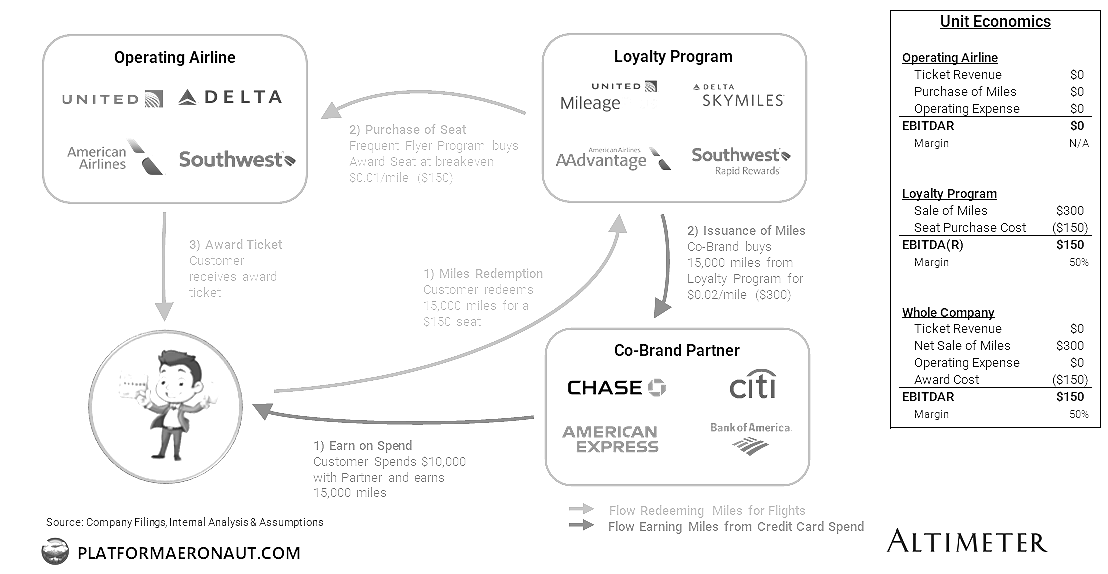
Every party acted rationally. Management took the cheapest available capital during a liquidity crisis. Bondholders lent against a 4x-covered senior position. None of it was wrong at the time. The mistake was that the entire structure assumed Spirit would remain a going concern. It solved the immediate liquidity problem while completely ignoring the strategic challenges Spirit continued to face.
The Merger That Could Have Saved Everything
Spirit continues to lose market share to the top 4. The next market opportunity to save Spirit came from M&A. In 2024, JetBlue offered to buy the airline for $33.50/share or $3.8 Billion. Strategically, it made sense. JetBlue and Spirit were both low cost carriers competing against the big 4 that were increasingly encroaching on their territory.
Unfortunately, the DOJ blocked the proposed acquisition citing market competition reasons and it was held up in court in January 2024. They said Spirit was a “disruptive maverick” whose presence on a route lowered fares, sometimes by 17% or more. ~30 million passengers flew on overlapping JetBlue/Spirit routes so a JetBlue/Spirit merger would lead to worse outcomes for consumers on specific city pairs.
JetBlue tried bringing up the failing firm defense arguing Spirit would exit the market without the merger. The DOJ didn’t buy it but they should have. Less than 2 years later, Spirit filed for chapter 11 and less than 4 years later it liquidated.
At the time, the DOJ was protecting consumers from a 5-10% fare increase on overlapping routes. In reality, they got a 100% fare increase as well as a route map with no competitor.
While the DOJ was not necessarily wrong for citing anti-competitive concerns, it focused on a narrow case of city-pairs while ignoring the broader market concerns. Spirit and JetBlue were both losing share to the big 4 and needed to consolidate if they wanted to compete effectively. The DOJ missed the big picture.
The Bankruptcies That Didn’t Fix Anything
The next market solution came in late 2024. Spirit filed for Chapter 11 bankruptcy in November 2024 to restructure their balance sheet and reduce costs. Spirit came to the Southern District Court of NY with an agreement between a majority of the debtors of the company. Effectively, the bondholders, which included Citadel, PIMCO and AllianceBernstein, took control of the company and put in $350M new money equity.
Unfortunately, deleveraging could not fix the core problems with the business which were operational and structural in nature. The business’s fundamental business continued to be challenged. They further had fleet issues with Pratt & Whitney partially grounding their fleet. Then, AerCap, a large aircraft lessor, terminated their leases in Mid July. They filed for bankruptcy again in August 2025.
The second bankruptcy was even more painful. The bondholder new money equity from just a few months ago was massively impaired (or wiped out). In October 2025, Spirit announced an aggressive cost-cutting plan. Unfortunately, then the Iran war started which massively increased fuel prices. On May 2, 2026, Spirit went into liquidation.
In the end, bankruptcies are not supposed to just “buy time.” They create opportunities to address key challenges, reduce costs, and either sell or turn around the business if it is structurally challenged. In this case, the bankruptcies did not address the structural challenges in the business, instead focusing on cost cutting.
Fuel price shocks are not exactly new to the airline industry. They happen once every five years. Airlines are ultimately driven by macro and geopolitics. The bankruptcies did not prepare the airline for what are common “tail risk” events for anyone that has looked at airlines - oil price shocks or macro demand challenges.
Is Anyone Solving For the Business?
The reality is every stakeholder was solving for some part of the business. Regulators solved for competition, creditors protected recoveries, management protected liquidity, and advisors protected the process. However, the ultimate outcome was one that everyone was trying to avoid. The challenge and lesson of Spirit is something that’s relevant for distressed broadly — everyone is solving for intermediate outcomes, but who is solving for the business as a whole?